People ask me this all the time: “How do I actually learn electronics?”
And I get it. You search online and find a ton of tutorials — oscillators, boolean logic, amplifiers, op-amps — and no clear idea of where to start or what you actually need.
I’ve been there. When I started, electronics felt impossibly hard. I’d pick up a book, hit a wall of jargon, and put it back down.
But here’s what I eventually figured out: electronics itself isn’t that hard. The way most people teach it is hard. That’s a big difference — and once you see it, learning electronics gets a lot more approachable.
This guide gives you a practical roadmap. Not a list of every topic you could ever study. But a realistic path from zero to building real circuits and actually enjoying it.
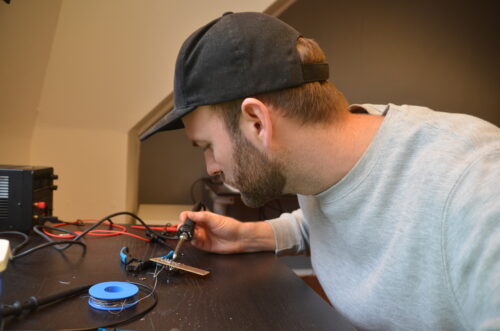
Why electronics feels harder than it is
A while back I sent out an email to my newsletter saying that electronics is actually not that hard.
One particular fella sent me an angry email in response. The person had spent 40 years in electronics and claimed he only knew 5% of it. How could I say it was easy?
On one side, I understand where he’s coming from.
I’ve also felt what he’s feeling. Learning electronics can be hard. Back when I started out, it felt really hard.
But what I also realized when I finally understood a new concept was that it wasn’t actually that hard. It was the explanations that I got that were hard, not the actual thing I had to learn.
For example: what’s a capacitor? Ask most textbooks and they’ll tell you it’s a “two-terminal passive device used to store electric charge, consisting of two or more conductors separated by an insulator.”
Even now that I know what a capacitor is, I need to re-read that sentence a few times to understand what they’re saying.
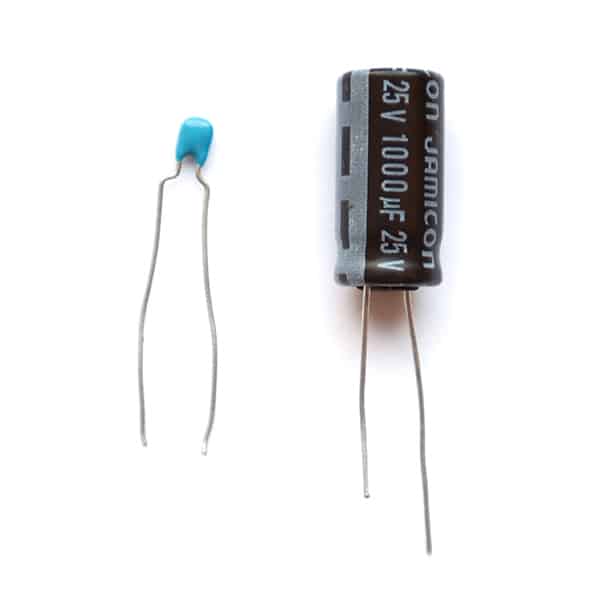
It’s technically accurate, but it’s also useless if you’re trying to build something!
Want to understand how a capacitor works without a single formula an no memorization of difficult words? Then build this circuit:

Use a 9V battery, a 1000 µF capacitor, and a resistor somewhere between 500–1000 ohms.
Connect the battery. The LED turns on. Nothing surprising yet.
Now disconnect the battery — and watch what happens.
The LED stays lit for a few more seconds, with no battery connected!
Here’s me building the circuit if you want to have a look:
That’s the capacitor. It charged up while the battery was connected, then used that stored charge to keep the LED running. It behaves a bit like a small battery — one that charges and discharges quickly.
No formulas. No physics lecture. Just a circuit that shows you exactly what a capacitor does.
What to actually focus on first
Here’s a question I get a lot: “I found a page with tutorials on oscillators, amplifiers, combinational circuits, boolean logic… where do I even start? Do I need all of it?”
No. You don’t need all of it. Not even close — at least not to get started.
In my opinion, knowing “the basics” of electronics comes down to:
- Having a good understanding of current, voltage and resistance: Not the definition of them. But the understanding of how they work. You should be able to look at a simple circuit, “see” how the current flows and what the voltages are (or how to find them) at key points around the circuit.
- Knowing how the basic components work: Resistors, capacitors, LED and transistors. You don’t need to learn every detail about them. But get a good understanding of what they do and how to use them.
- Knowing how to build simple circuits: You’ll get a much better understanding from building (even simple) circuits that you’ll never learn by just reading. But even more – you’ll build confidence in your skill.
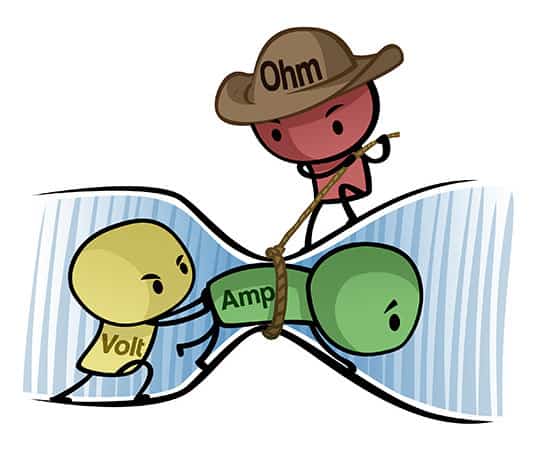
If you feel solid on those three things, you know the basics.
From there, learn what you need for your projects, or topics that you’re interested in. Don’t feel that you have to learn about filters if you have no need for them nor any interest in them right now.
Build first, understand second
Here’s something that surprised me when I started teaching: you can be good at building circuits without fully understanding them. And you can understand circuits well on paper but freeze up when it comes to actually building.
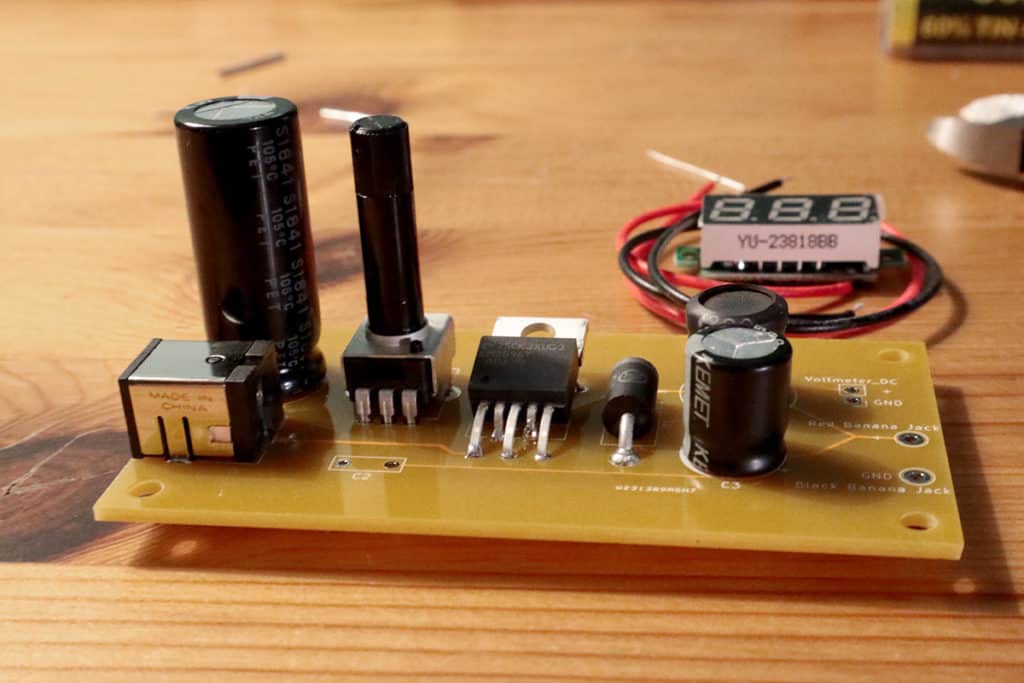
These are two different skills.
Josh Kaufman’s book The First 20 Hours argues you can become genuinely proficient at almost any skill in 20 hours of focused practice. I think that’s true for electronics too. Not world-class — but good enough to build real things and enjoy it.
The key word is focused. Not 20 hours of browsing tutorials with half your attention. Twenty hours of actually building — soldering, wiring, troubleshooting when it doesn’t work.
When something confuses you while building, look it up. The understanding sneaks in on its own.
What bad advice on learning electronics looks like
I watched a video a while back that bothered me.
An electronics engineer was answering questions on YouTube. Someone asked him for tips on how to learn electronics. He visibly squirmed, then said something like: “Hmm, I don’t know… just study hard… it takes a lot of time… but in the end it’s worth it.”
I didn’t like that advice at all.
“Study hard” — study what, exactly? Hard how?
“It takes a lot of time” — to become an expert, sure. But to reach a level where you’re building cool things and genuinely enjoying it? That can happen pretty fast.
And “in the end it’s worth it” — for me, it was worth it right from the beginning. If you can’t enjoy it until you’re “really good,” maybe ask whether you’re approaching it the right way.
So here’s what I’d say instead:
- Have fun with it. Seriously. Enjoyment is not a reward for mastery — it’s what keeps you going long enough to get there.
- Learn the basic theory — not all theory, just enough to get started. Current, voltage, resistance. A handful of components. That’s it for now.
- Build a lot of circuits. You’ll learn more from building than from any book or video. There’s no substitute for it.
- Find a project you actually care about and work toward it. The gaps in your knowledge will show up naturally — and filling those specific gaps is a much better use of your time than trying to study everything upfront.
- If you don’t have a project in mind yet, pick a topic that genuinely fascinates you — microcontrollers, amplifiers, 555 timer circuits — and start there.
And ignore any advice that makes electronics sound like a punishment. It doesn’t have to be hard.
A practical learning path for beginners
Here’s the order I’d recommend if you’re starting from scratch:
- Get the basics of current, voltage, and resistance — enough to understand what’s happening in a simple circuit. Ohm’s Law is the foundation.
- Learn to read a basic circuit diagram (schematic) — you don’t need to read complex schematics right away, but being able to follow a simple one opens up a huge library of projects.
- Build something on a breadboard — a blinking LED is the classic first project. It sounds trivial. It isn’t. Getting it to work teaches you more than hours of reading.
- Learn the main components by using them — resistors, capacitors, LEDs, transistors. Build circuits that use them. Let the “why” follow from the “what.”
- Move to microcontrollers (optional) — once you’re comfortable with basic circuits, adding a microcontroller like an Arduino opens up a completely new world. Now your circuits can make decisions, respond to sensors, and control things. This is is a lot of fun, but not everyone wants to take this step.
Each step builds on the previous one. You don’t need to master any step before moving to the next — just get comfortable enough to move forward.
How long does it actually take?
Honestly? To get to the point where you can build real projects and have fun? Not long.
With consistent, focused practice — a few hours a week — most people get to a genuinely enjoyable level within a few weeks.
Becoming an expert takes longer, obviously. But nobody is asking you to become an expert before you’re allowed to enjoy it. You can start having fun almost immediately.
The people who struggle longest are usually the ones waiting until they “really understand” everything before they allow themselves to build. Don’t do that. Build now, understand as you go.
Where to learn electronics online
There’s no shortage of free content online. But free and scattered is a lot harder to learn from than structured and guided — especially when you’re starting out and don’t know what you don’t know.
At Ohmify, the courses are built around the practical learning path described above. You start with the fundamentals, move into components and basic circuits, and then get into hands-on projects and microcontrollers — all taught the way I wish someone had taught me, with practical explanations instead of physics lectures.
There’s also a community of learners at every level, so when you get stuck (and you will — everyone does), you’re not stuck alone.
Ohmify is a membership, so all courses are included once you join.
The short version
Learning electronics isn’t as hard as it’s often made out to be. The fundamentals are learnable. The basics — current, voltage, resistance, a handful of components — are enough to start building real things.
What actually separates people who learn electronics from people who don’t isn’t aptitude. It’s whether they commit and start building.
Pick up a breadboard. Build something. Look up what confuses you. Repeat. That’s the whole method.
Want more guides on learning electronics? Head back to the Ohmify guides index to explore more topics.